怪谈百物语
鸡娃圈偏爱!为什么新加坡数学这么受欢迎?_我的网站

A | 家长们都知道,新加坡的基础教育在世界上处于一直领先地位。近年来,随着新加坡数学的热度越来越高,孩子数学启蒙,很多家长都选择采用新加坡的教学方法。
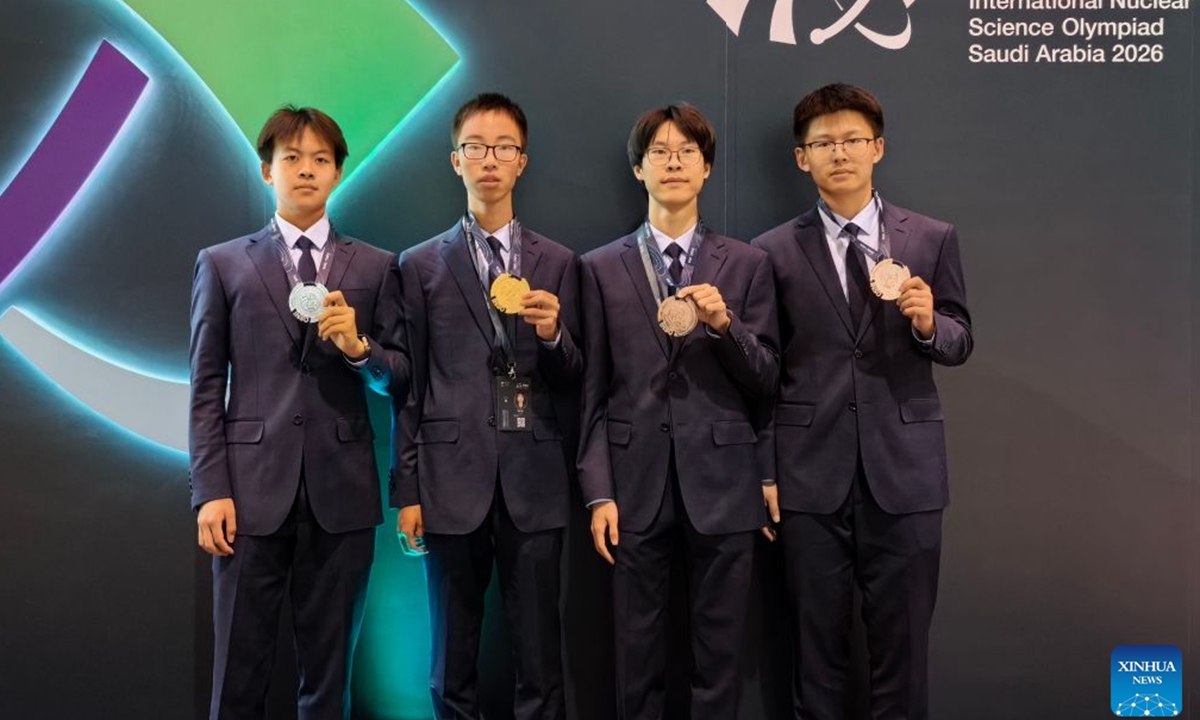
Four high school students from Beijing, China, who represented China at the third International Nuclear Science Olympiad (INSO) for the first time, pose for a group photo with their medals in Jeddah, Saudi Arabia, on August 8, 2026. Photo: Screenshot from the Xinhua News Agency
China won one gold and three silver medals at the third International Nuclear Science Olympiad (INSO) in Jeddah, Saudi Arabia on Saturday, marking the country's debut at the competition, according to Xinhua News Agency.
The four-member Chinese team ranked among the top participating countries. The eight-day event brought together teams from 19 countries, with theoretical and experimental exams covering nuclear physics, radiation protection and nuclear fuel, among others, reported Xinhua.
Organizing committee representative Talal Alrashidi welcomed China's participation, saying the students delivered an outstanding performance and demonstrated the positive spirit of Chinese youth.
Gold medalist Liu Siqi, a student from Beijing No. 80 High School's Wangjing Campus, said competing with outstanding young people worldwide has "strengthened my determination to study hard and scale new heights in science."
"We will continue to strengthen the popularization of nuclear science and encourage more outstanding young people to learn about, understand and participate in the nuclear field," Wang Peng, head of the Chinese delegation, deputy chief economist of the China Institute of Nuclear Industry Strategy, and president of the China Atomic Energy Press, was quoted by Xinhua as saying.
INSO is currently a leading nuclear science competition for secondary-school students, promoting scientific excellence and international cooperation in the field of nuclear science and technology. INSO is organized with support from the International Atomic Energy Agency, in collaboration with host governments and partner institutions. It is modeled after other international science olympiads, such as the International Physics Olympiad and the International Chemistry Olympiad, but focuses specifically on nuclear science and its peaceful uses, according to the official INSO website.
As the world's first youth Olympiad dedicated to nuclear science, INSO aims to stimulate young people's interest in the field and promote international exchanges, said Xinhua.
Global Times
。特别是一些咱们国内的国际学校,也会采用新加坡数学来给孩子启蒙。许多学习了新加坡数学的孩子也已经在
袋鼠、新加坡SASMO、AMC等等数学竞赛斩获了金奖无数。那么,被称为
“世界第一”的新加坡数学到底牛在哪?是怎么学的?今天就为你揭秘!
新加坡的数学教育 新加坡数学确实有着一套非常成熟且备受赞誉的教学结构。新加坡数学的教学方式强调
对基础概念的理解,以及
问题解决能力的培养。

B | 国际上非常权威的学生能力测评TIMSS和PISA中,新加坡的学生在数学项目中始终名列前茅。图源:PISA官网现在全球有超过40多个国家把新加坡数学作为教材。

C | 在中国,新加坡数学同样受到欢迎。虽然中国数学在计算和技巧上的表现很出色,但在理解数学概念和培养数学思维方面,确实存在一些“短板”。而新加坡数学则提供了一种中西合璧的解决方案,可以在保持与中国数学接近的进度和难度的同时,又与英美的数学思维和英语表达方式接轨。那么,新加坡数学究竟采用了什么样的教学方法呢?数学学习利器——CPA教学法 新加坡数学的一大特点就是使用“具象化模型(CPA教学法)”讲解数学概念和解题思路。理解后再辅以适当的练习,极大地降低了孩子理解抽象数学概念的难度。CPA教学法,又称 “三步教学法”,在数学启蒙阶段,帮助孩子建立良好的“数感”,包括了三个方面:C - Concrete 具象化P - Pictorial 图形化A - Abstract 抽象化那么对比中国以及欧美,新加坡的CPA教学法到底强在哪呢?接下来就举个例子,让家长们能形象的了解这三大数学学习体系的区别。举个例子问题是:有1个苹果和2个橘子,问一共有多少个水果。中国孩子看到题目会直接摆出算式:1+2=3;欧美孩子会画出1个苹果和2个橘子,数一数有3个水果;新加坡孩子则会这么做:通过画模型的方式,把抽象概念具体化,然后再转换为1+2=3的等式。

D | 看似CPA好像让一个简单的数学问题变得多了一个步骤。但是对于孩子来说,相比于“一步到位”的抽象,多了一个过渡的阶段,帮助学生更好地适应不同年龄阶段的数学学习内容。通过激发孩子的学习兴趣和参与度,培养他们的数学思维和解决问题的能力。这对于学生的长期发展和未来学习具有重要的意义。进阶学习:适应孩子的学习规律 通过将具像化、形象化和抽象化三种思维模式阶梯式过渡的教学方法,可以帮助学生更好地适应不同年龄阶段的学习内容。激发他们的学习兴趣和参与度,培养他们的数学思维和解决问题的能力。图源:新加坡教育部官网这种递进式的学习,对于学生的长期发展和未来学习具有重要的意义。

E | 其实仔细对比,中国与新加坡的教材大纲都差不多,只是在安排顺序、深度、广度上有些许差别。第一阶段 适合年龄:3-6岁内容重点:包含了50以内的数数,20以内的加减,5以内的乘法以及基本的形状、颜色、时间。

F | 难度体现:题目难度是循序渐进的。虽然全文都是英文,且在内容里还会涉及英语的学习,但是以图片为主,没有英语基础也可以学。

G | 第二阶段 适合年龄段:6-9岁内容重点:100以内的加减,1000以内的加减,10000以内的加减,乘法,除法,钱币换算,时间,形状,容量,重量,长度的测量和计算,平面几何、角、面积、条形统计图、分数。

H | 难度体现:在这个阶段,需要用建模练习数字结构,用建模法数字结构讲解加法,也会更重视应用题的练习。第三阶段 适合年龄:9-12岁内容重点:6位数以内加减,8位数的读写,3位、4位数的乘法除法,分数、小数的加减乘除,平面几何,立体几何,时间计算,图表,比率,小数、分数和百分比的转换,平均数,代数,速度计算。难度体现:开始要求孩子根据线形图表分析数据,图表题将几何、分数等内容结合在一起,而且平面几何题开始涉及立体几何和空间思维。阅读理解的句式也变得更加复杂了,涉及内容也更加深广。
Current article:http://q8gg5xf.qiniaohongfangfoguisenzhai.cyou/t1t/q9tvus3.html
Published on:05:41:09


